At a glance: A West Bengal Board day school in Kolkata, with more than 1,000 students, had always released children during school hours against a gate pass, issued by the front office to whoever came to collect them. In May–June 2026 it added a step borrowed from e-commerce deliveries. When someone arrives to collect a child, a one-time password goes to the parent’s registered number by SMS and app notification, and the front office issues the gate pass only when the person at the desk can quote it and has been photographed. There was some friction in the first weeks, including a driver who had to wait because he could not reach the parent for the OTP. Parents did not complain. They thanked the school, and the feature has become a visible sign to every family that the school takes their child’s safety seriously.
The problem
The gate pass is one of the oldest controls in an Indian school. When a parent or guardian comes to take a child home during the school day, they go to the front office, the office issues a slip, and the guard at the gate will not release the child without it. Some schools, especially those with hostels, also note when the child comes back. This school had run its gate pass the same way for years.
The weakness was never the slip. It was the moment before the slip was written. The front office had to decide whether the adult standing in front of it — a parent, an uncle, a neighbour, a driver the family had sent — was really someone the parents wanted to take their child. That decision rested on recognition, a phone call if anyone thought to make one, and trust.
Most days that is enough. But a school of more than 1,000 children sees a steady stream of early collections, and the front office cannot know every family’s arrangements. A gate pass that is issued on a judgement call is only as safe as that judgement.
From recognition to verification
The gate pass is issued against the parent's OTP, not against whether the front office recognises the adult
A small delay, and a great deal of confidence
What changed
The idea came from something every parent already does several times a month. When a parcel arrives, the delivery person cannot hand it over without the OTP sent to the buyer’s phone. Nobody finds that insulting. It is simply how a valuable delivery is handed over to the right person. The school applied the same logic to the most valuable handover it makes. Using Vawsum’s Gate Pass Management System, part of Vawsum Secure+, it set up the process like this:
- Request at the front office. Whoever has come to collect the child goes to the front office, which starts a gate pass for that student.
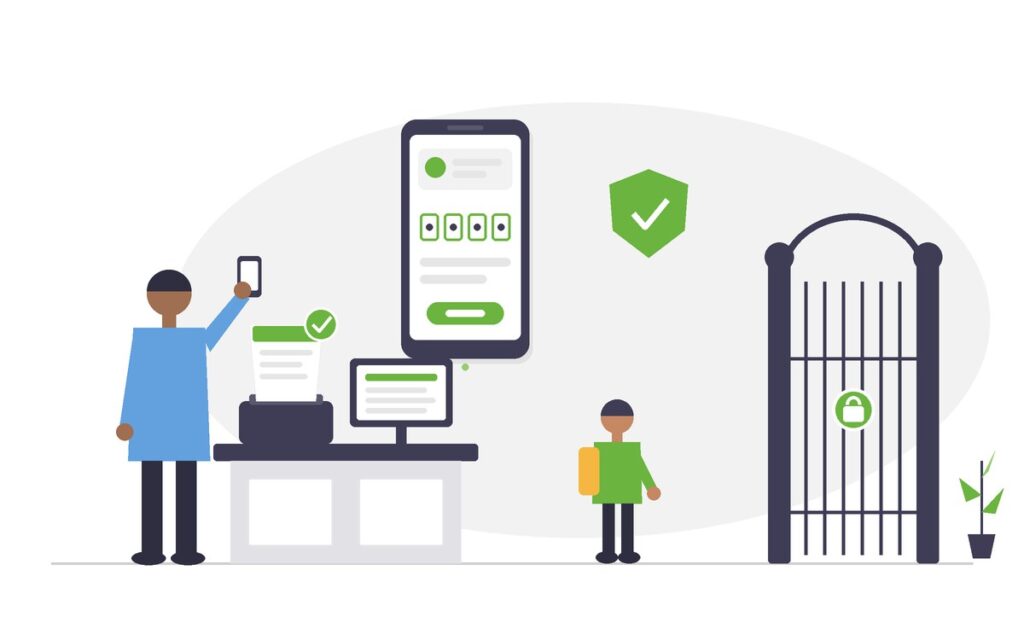
- An OTP to the parent, by SMS and app notification. The system sends a one-time password to the parent’s number registered on the student’s record, through both SMS and the Vawsum app, so it reaches the parent whichever they check first.
- No OTP, no pass. The person collecting the child has to get the OTP from the parent and quote it at the desk. Only when it matches does the front office issue the gate pass. A parent who has not sent anyone simply does not share the OTP, and finds out straight away that someone asked.
- A photo of the person collecting the child. Before the pass is issued, the front office must take a photograph of the adult who has come for the child. The step is mandatory, so every early release carries a picture of exactly who took the child out of school.
- A reason recorded every time. Each pass is issued against a reason chosen from a list — sick, doctor’s appointment or family emergency at this school — rather than written in by hand. Schools can configure their own list.
- A printed pass for the gate. The front office prints the issued pass, and the guard releases the child against it, just as before. The gate routine did not change; what changed is what stands behind the slip.
The result
The school expected some pushback, as it would with any new step at the gate, and the first weeks did bring some friction. Collections took a little longer while families got used to the routine, and parents and their drivers sometimes had to wait.
The clearest example came early on. A family’s driver arrived to collect a child but could not get through to the parent for the OTP. The front office did not issue the pass, and the child was not released until the parent could be reached. The child went home later than planned. The parents’ response was not a complaint — they thanked the school. The delay was proof that the school would not hand their child to anyone, even someone familiar, without their say-so.
That set the tone for the rest of the rollout. The friction ended up building support rather than eroding it. Parents told the school they welcomed the change wholeheartedly: it showed the school cared, and that there was a real process around their child. In a West Bengal Board school, where this kind of safeguard is rarely seen, the feature stood out.
The school has made the most of it. Its message to parents is simple: we are as careful with your child as an e-commerce company is with a parcel, and we use technology every day to make sure of it. Because the OTP lands on every parent’s own phone, every family experiences that care directly — which no notice or brochure could achieve.
The school also now holds something it never had with handwritten slips: a record of every early release, with the reason and a photograph of the person who collected the child. Whether a child left because they were unwell, had a doctor’s appointment or had a family emergency, the answer is on file rather than in someone’s memory.
FAQs
How does the parent receive the OTP?
By SMS and by notification in the Vawsum app, both sent to the number registered on the student’s record, so the parent gets it whichever they check first.
What happens if the person collecting the child cannot reach the parent?
The pass is not issued until the OTP is provided. At this school, that once meant a driver had to wait — and the parents thanked the school for holding firm.
Why photograph the person collecting the child if they already have the OTP?
The OTP proves the parent approved the collection. The photo records who actually turned up. Together they give the school a complete answer if a release is ever questioned later.
Does the guard at the gate need a device?
Not at this school. The front office verifies the OTP and prints the issued pass, and the guard releases the child against the printed pass as before.
Can the school choose its own exit reasons?
Yes. Reasons are configured by the school. This school uses sick, doctor’s appointment and family emergency, and others can be added as needed.
Does the extra step slow down early collections?
A little, at first, while families get used to it. At this school, parents saw that brief wait as proof that the process works, and support for it grew rather than fell.
See related case studies: how a multi-branch Kolkata school tracked transport with QR codes alone, how a Kolkata residential school made hostel attendance verifiable with four daily checkpoints, how a Jalpaiguri school rebuilt ID card renewal in two days, and how a residential CBSE school in Sikkim rolled out NEP holistic progress cards for every class and every exam.

Recent Comments